

Could the Wegovy® Pill Be Right for You?
A Guide to the New Injection-Free GLP-1 Option
Obesity is a chronic, complex condition, and for many patients in the UK, GLP-1 treatments have already made a meaningful difference to how it is managed. The introduction of an oral tablet format represents a genuinely significant step, not simply because it is new, but because it has the potential to reach patients who may never have considered treatment before.
Wegovy Pill (semaglutide) is now available as a once-daily oral tablet, offering an alternative to the weekly injection that many patients will already be familiar with. For those who have been clinically appropriate candidates for GLP-1 treatment but have delayed or declined due to concerns about injections, this method is worth considering.
What is the Wegovy pill?
The Wegovy pill is a once-daily oral tablet containing semaglutide, the same active ingredient found in the Wegovy injection. It works in the same way as the injectable version, mimicking a hormone called GLP-1 that your body naturally produces to help regulate appetite. By reducing hunger signals, it helps you eat less and, when combined with a reduced-calorie diet and increased physical activity, supports meaningful weight loss over time.
Like the injection, the pill is a prescription-only medication intended for adults living with obesity, or for adults who are overweight and have at least one weight-related health condition such as high blood pressure or high cholesterol.
What do the clinical results show?
In a 64-week medical study of 307 adults, those taking the Wegovy pill alongside a reduced-calorie diet and increased physical activity lost on average 14% of their starting body weight, roughly 33 pounds based on the average starting weight in the study. By comparison, those taking a placebo lost around 2.4% of their body weight. Around 76% of adults taking the pill achieved at least 5% weight loss, compared with 31% in the placebo group. Additionally, 28% of adults taking the Wegovy pill lost 20% or more of their body weight.
Beyond weight loss, participants also experienced improvements in waist size, cholesterol, and blood sugar levels, though it is important to note the pill is not currently approved to treat those conditions specifically.
How does the pill compare to the injection?
This is the question most patients will naturally ask. The honest answer is that both formats contain the same active ingredient, but they are not identical in every respect.
The pill is taken once daily and needs to be taken at a consistent time, before food. The injection, by contrast, is taken once weekly. For some people that distinction will matter a great deal. A daily commitment requires a different kind of routine than a weekly one, and it is worth being honest with yourself about which you are more likely to stick to. For patients who have avoided treatment because of needle anxiety, or who find injections impractical for their lifestyle, the pill may genuinely be a better fit. For existing patients already achieving good results on the injection, switching is not necessarily the right move without a conversation with a clinician.
Moving from injections to the Wegovy pill
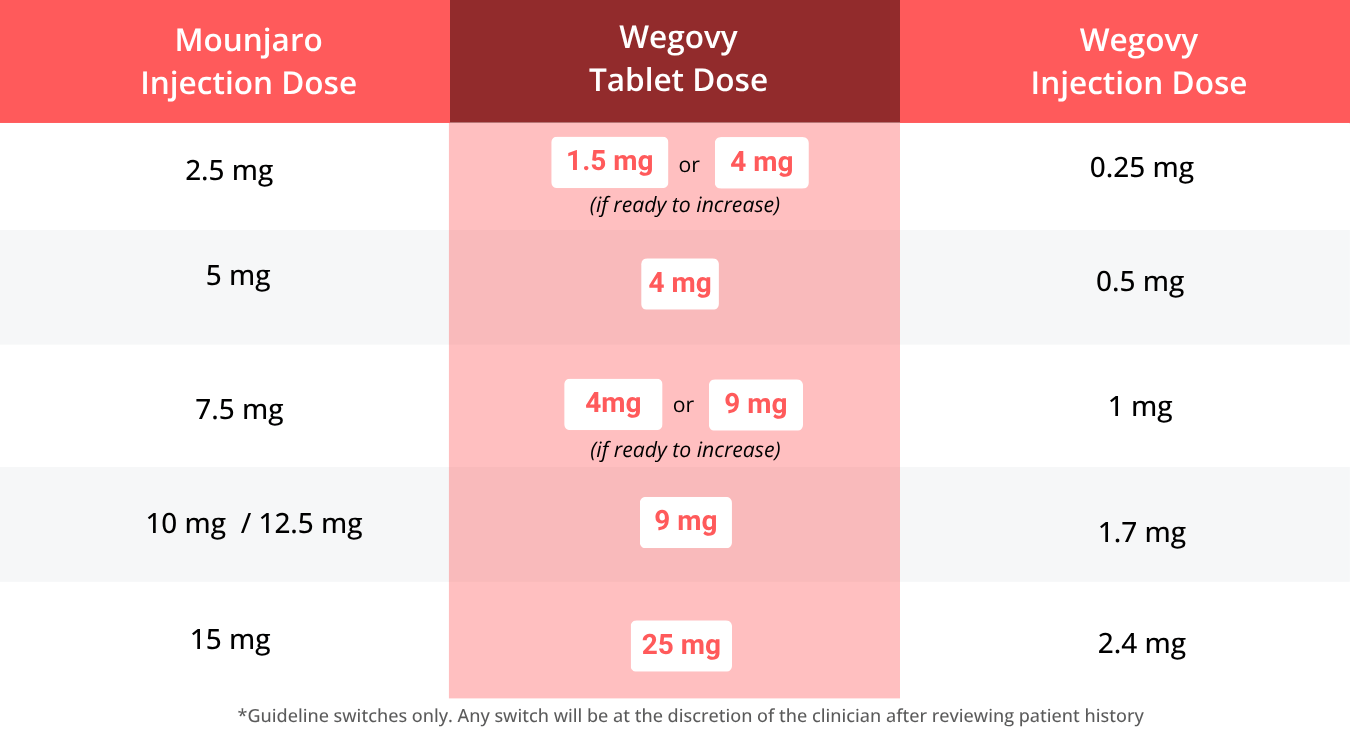
Making the switch from an injectable GLP-1 to the Wegovy pill is possible, but it is not as simple as swapping one dose for another. The way your body absorbs oral semaglutide is fundamentally different from how it absorbs the injectable form, and no official equivalence guidance exists between tirzepatide and oral semaglutide at all. Your actual starting dose will always be confirmed by a clinician after a full review of your medical history, how well you have tolerated your current treatment, and your individual circumstances.
Who might be most suited to the pill?
The pill is likely to open doors for people who have been sitting on the fence about GLP-1 treatment. Research consistently shows that needle aversion is a real barrier, and a tablet format removes it entirely.
It may also be appealing for people who travel frequently, where storing and transporting injectable medication adds complexity, or those who simply find a daily tablet easier to work into existing routines.
That said, the same research highlighted that existing patients considering a switch have higher standards. The vast majority said they would only consider changing if the pill matched the effectiveness of their current treatment.
What about stigma?
This matters. Obesity is a chronic, complex medical condition, not a lifestyle choice. For many people, the idea of taking a tablet rather than an injection feels less exposing, less clinical, and easier to manage privately. Anything that helps people access effective treatment without shame or secrecy is a positive development.
Is the Wegovy pill available in the UK right now?
We would encourage you to speak with one of our clinicians directly about your options and current availability. GLP-1 treatment of any format is always prescribed following a proper clinical assessment to ensure it is appropriate for you.
A note on safety
Wegovy is a prescription medication and carries important safety information that should be discussed with a healthcare professional before starting treatment. It is not suitable for everyone. As with all GLP-1 treatments, common side effects can include nausea, vomiting, diarrhoea, and constipation, particularly in the early stages of treatment.
Wegovy should not be used by anyone with a personal or family history of medullary thyroid carcinoma (MTC) or Multiple Endocrine Neoplasia syndrome type 2 (MEN 2), or by anyone who has had a serious allergic reaction to semaglutide.
Want to find out if GLP-1 treatment is right for you?
Whether you are interested in the injection or the pill, our team is here to help you understand your options and find the right treatment pathway for you. Start with a free online assessment today.
