


How to Inspect and Use Your Mounjaro® KwikPen Safely
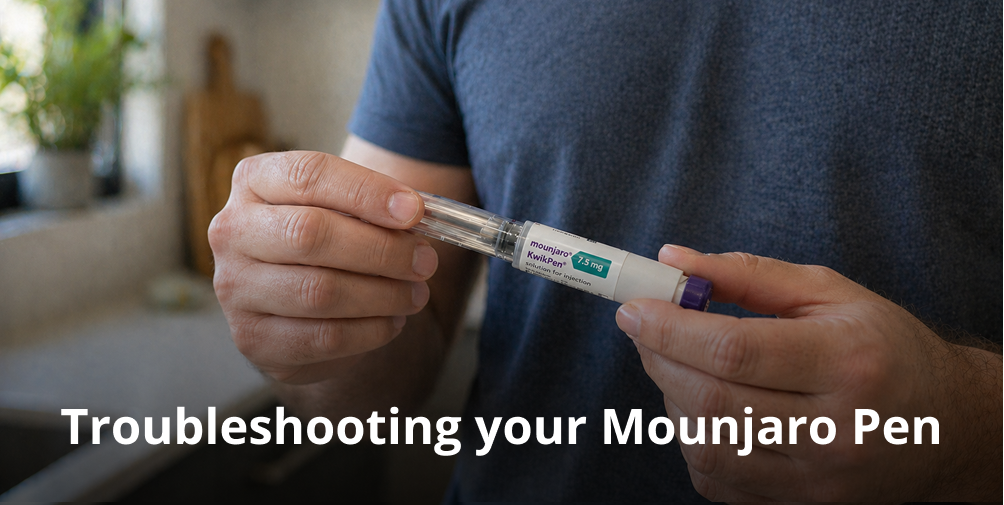
Using your Mounjaro® KwikPen correctly is essential to ensure you receive the full dose of medication safely and effectively. This guide walks you through how to check, prime, and troubleshoot your pen.
If you are interested in getting started on your weight loss journey please click here to start a free consultation and see if our treatments plans are suitable for you.
Tips to Prevent KwikPen Issues
Taking a few simple precautions can help keep your KwikPen working smoothly and ensure you receive your full dose each time.
Follow the instructions carefully
Always use the pen exactly as described in the manufacturer’s instructions. It’s designed to deliver one full dose per week, and the mechanism limits how far the dose knob can turn, so avoid overusing or forcing it.
Handle your pen with care
This is a medical device, so it’s important to store and handle it properly. Avoid dropping it or exposing it to damage.
Keep your pen clean
Don’t carry the pen loose in your bag or pocket where it can collect dust or debris. Small particles can interfere with the mechanism.
Never use the pen without a needle attached
Twisting the dose knob or pressing it without a needle in place can cause pressure to build inside the pen. This may damage the internal seal and affect how the medication flows.
Use a new needle every time
Reusing needles can lead to:
o Blockages
o Contamination
o Inaccurate dosing
o Increased internal pressure in the pen
Remove the needle after each use
Always take the needle off after your injection. Leaving it attached can cause the pen to leak or allow air to enter.
Attach the needle correctly
Push the needle on straight and firmly. Check that it isn’t bent, and avoid attaching it at an angle, as this can damage the pen.
Check your needle type
Some needles are push-fit, while others twist on. If you’re using your own needles, make sure you know which type you have and that it’s securely attached before use.
Inspecting your pen before injecting
Before You Start: Inspect Your KwikPen
Always check your pen before use:
Ensure the pen is not damaged
Check that the red inner seal is flat and intact
If the red inner seal is damaged, do not use the pen.
Does Your Pen Contain Enough Medicine?
Each KwikPen contains:
2.4 ml of medication
4 fixed doses (0.6 ml each)
A small extra amount to allow for priming
It’s important not to over-prime, as this can reduce the number of full doses available.
You can confirm all 4 doses have been delivered by checking the plunger position. After the fourth dose:
Some liquid may remain — this is normal
You will not be able to dial another full dose after the fourth dose is completed
The pen should be safely disposed of, even if liquid remains
Attempting to use leftover medication may result in an incomplete and unsafe dose.
Has the Pen Been Primed?
Priming removes air and ensures the pen is working correctly.
To check if priming has been successful:
A small drop of medicine should appear at the needle tip
A visible stream is not required
Always follow the priming instructions carefully to ensure accurate dosing.
Mounjaro® (tirzepatide) KwikPen®: The Importance of Priming Your Pen
Priming your KwikPen is a simple but essential step to make sure your medication is delivered correctly. It removes air from the cartridge and confirms the pen is working as it should.
When Should You Prime the KwikPen?
You should prime the pen before every injection. Skipping this step could mean you don’t receive your full dose.
How to Prime Your KwikPen
Priming is outlined in the official Instructions for use. Here’s a clear, step-by-step guide:
Step 1: Attach a New Needle
Always use a new pen needle for each injection to reduce the risk of infection and blocked needles
Pull off the paper tab from the outer needle shield
Step 2: Secure the Needle
Push the capped needle straight onto the pen
Twist until it is firmly attached
Step 3: Remove the Needle Caps
Pull off the outer needle shield and keep it (you’ll need it later)
Remove and discard the inner needle shield
Step 4: Set the Prime Position
Slowly turn the dose knob until you hear 2 clicks
The extended line should appear in the dose window — this is the prime position
If needed, adjust by turning the knob in either direction until it lines up correctly
Important:
Do not dial more than 2 clicks when priming
If you dial too far, you can turn it back as long as you haven’t pressed the dose knob
Over-priming can waste medication and may prevent you from receiving all 4 full doses
Step 5: Remove Air Bubbles
Hold the pen with the needle pointing upwards
Gently tap the cartridge holder to move air bubbles to the top
Step 6: Release a Small Amount of Medicine
Press the dose knob fully until it stops
Hold it down and count slowly to 5
Check the dose window shows “0”
Do not inject into your body during this step
How Do You Know Priming Was Successful?
Priming is successful if you see a small drop of medicine at the tip of the needle.
A steady stream is not required
Even a tiny drop confirms the pen is ready to use
How Many Times Can You Prime?
The KwikPen is designed to allow:
Up to 8 priming attempts (if needed)
Delivery of 4 fixed doses (0.6 ml each)
If you prime more than 8 times over the life of the pen, you may not be able to dial the final (4th) dose.
What If No Medicine Appears?
If you don’t see a drop of medicine after priming:
Repeat Steps 4 to 6
If still no drop appears, repeat these steps again
If the issue continues:
Attach a new needle
Repeat Steps 7 to 9
If you still do not see any medicine after following these steps, contact your healthcare provider or your local support service for further advice.
Key Takeaways
Always prime before every injection
Use a new needle each time
Never dial more than 2 clicks when priming
Look for a small drop to confirm success
Avoid over-priming to ensure you receive all 4 full doses
If the Dose Knob Is Hard to Push
This can happen, but there are simple ways to resolve it.
Check Your Injection Technique
Always prime before each injection
Press the dose knob slowly and steadily
Ensure Proper Needle Use
Always use a new needle for each injection
Make sure the needle is:
Not bent or damaged
Securely attached
Never press the dose knob without a needle attached, as this can increase pressure inside the pen
Check Storage Conditions
Store the pen in a clean, dry place
Always:
Keep the cap on
Store without a needle attached
If the pen has been exposed to dust, lint, food, or liquid, it may malfunction and should be disposed of.
What to Do If the Dose Knob Is Still Difficult to Press
Follow these steps:
Attach a new needle
Remove both the outer and inner needle caps (keep the outer cap)
Turn the dose knob back to “0”
Press the dose knob
Repeat the priming steps
Using a new needle often resolves flow issues.
Why a Mounjaro® Injection Might Leak
Seeing a small amount of liquid at your injection site after using Mounjaro® (tirzepatide) can feel worrying but in most cases, it’s completely normal. A tiny drop of fluid after a subcutaneous injection does not usually mean your dose has been lost or that the injection has failed.
Understanding why this happens can help you feel more confident in your technique.
Common Reasons for Injection Leakage
1. Needle Removed Too Quickly
One of the most common causes of leakage is taking the pen away from the skin too soon.
With the KwikPen, the medication is delivered under the skin (subcutaneously). After pressing the dose knob:
You should hold the pen in place for a slow count of 5 seconds
This allows the full dose to enter the tissue and begin absorbing
If the pen is removed too quickly, a small amount of medication can track back along the needle path and appear on the skin.
2. Injection Site Choice
Mounjaro can be injected into:
Abdomen (stomach)
Thigh
Upper arm
Some people may notice slightly more leakage in areas with less fatty tissue or if injecting into the same spot repeatedly.
Tip:
Rotate your injection site each week to:
Improve absorption
Reduce irritation or scar tissue
Minimise leakage risk
3. Natural Backflow (Normal Physiology)
Even with perfect technique, a small amount of fluid can sometimes come back out. This is called backflow and happens because:
The injection creates a tiny channel in the skin
A small amount of fluid may follow that path back out
This is normal and does not affect your dose in any meaningful way.
4. Injection Pressure and Volume
Mounjaro pens are designed to deliver a fixed, measured dose, and the mechanism ensures the correct amount is administered.
Even if you see a drop of liquid afterward:
It is typically minimal and not clinically significant
The full dose is still considered delivered when used correctly
Normal vs. Problematic Leakage
Knowing the difference can help you decide what to do next.
What’s Normal
A small drop of clear or slightly yellow liquid
A tiny spot of blood (from a small capillary)
No action needed. Do not re-inject.
What Might Be a Concern
A larger amount of liquid or visible wetness on the skin
Liquid spraying or streaming out during or after injection
The dose knob not returning to “0” after injection
In these cases:
Do not take another dose
Contact your pharmacist or healthcare provider for advice
How to Minimise Injection Leakage
A few simple technique adjustments can make a big difference:
Use the Correct Technique
Hold the pen firmly against the skin at a 90° angle
Press the dose knob fully
Keep the pen in place for a slow count of 5 seconds after injection
Remove the Pen Carefully
Withdraw the needle slowly and straight out
Avoid pulling away at an angle
Apply Gentle Pressure
Use a cotton ball or gauze
Apply light pressure for a few seconds
Do not rub, as this can irritate the area
Rotate Injection Sites
Alternate between abdomen, thigh, and upper arm
Use a different spot each week, even within the same area
Prime the Pen Correctly
Always prime before injection as instructed
This ensures proper flow and removes air from the pen
| Scenario | Likely Cause | Effect on Dose | What to Do | What Not to Do |
|---|---|---|---|---|
| Small drop of liquid | Normal backflow | No meaningful impact | Apply gentle pressure | Don't re-inject |
| Small drop of blood | Minor capillary | No impact | Apply gentle pressure | Don't rub or panic |
| Larger leakage | Technique issue or rare fault | Possible partial dose | Seek advice | Don't take another dose |
| Dose window shows "0" | Injection complete | Full dose delivered | Continue as normal | Don't assume failure |
If you ever notice significant leakage, unusual behaviour from the pen, or you’re unsure, it’s always best to speak to your pharmacist or healthcare provider for guidance.
Still having issues?
If the steps above haven’t resolved the issue, contact our team with:
Date of first dose
Details of the issue
Whether leakage has occurred
Photos of the pen and red seal
A short video showing the issue
Do not dispose of the pen until advised.
